Ganga Devi
A pioneering Madhubani artist whose finely controlled line and narrative imagination carried Mithila’s visual traditions from ritual walls to paper, museums and international audiences.
Biography
Ganga Devi was born in Chatra village in Madhubani district, Bihar, into a Kayastha family. Women in her community painted ritual spaces for occasions such as marriage, and these practices shaped the visual vocabulary she would develop throughout her career. As she began making work on paper, the portable surface gave her room to test line, colour and composition beyond the walls and floors of ritual settings.
Known for delicate drawing and narrative scenes, Devi reworked stories from the Ramayana and Krishna traditions, then broadened her subjects to include everyday life. Her 24-part Cycle of Life (begun in 1982) brought people, animals, trees and birds into continuous compositions rather than separating each scene into compartments. She continued to make art while receiving cancer treatment in Delhi; her four-part Cancer Series records illness, loss and journeys between Delhi and Madhubani. She died in New Delhi in 1991.
Her work is now held in collections including the Mithila Museum in Japan. A large kohbar ghar she completed at the Crafts Museum in Delhi in 1990 was later painted over during the museum’s 2015 renovation.
Awards & Honours
- National Master Craftsman Award, Government of India (year not consistently documented in the sources consulted)
- Padma Shri, Government of India (1984)
Exhibitions & Residencies
- Indian Folk Art and Culture exhibition, Washington, D.C. (1985)
- Invited to the Mithila Museum, Japan, to make Madhubani paintings for its collection (1988)
- Completed a kohbar ghar mural at the Crafts Museum, New Delhi (1990)
Selected documented presentations and institutional projects; not a complete exhibition list.
Selected Works
Artwork 349 · Ganga Devi
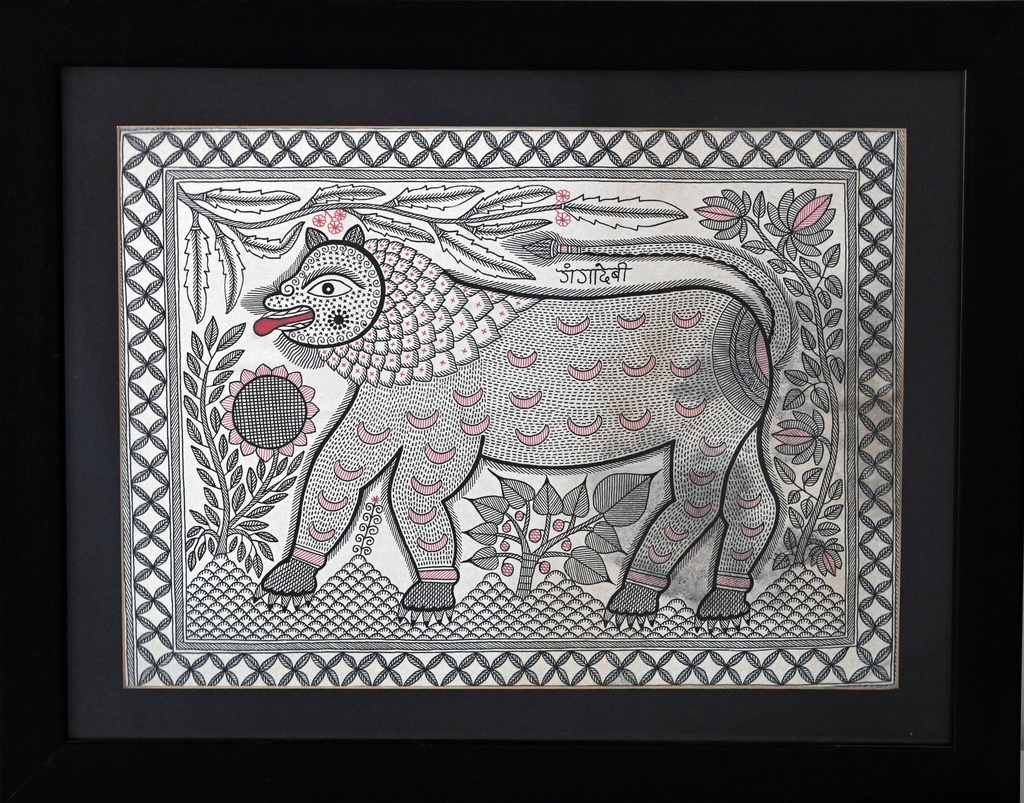
The Foundation catalogue describes a patterned, black-and-red animal drawing framed by foliage and floral motifs. Its record identifies acrylic on canvas and the Indian folk tradition (Madhubani style).
Research
Ganga Devi
A pioneering Madhubani artist whose finely controlled line and narrative imagination carried Mithila’s visual traditions from ritual walls to paper, museums and international audiences.
Biography
Ganga Devi was born in Chatra village in Madhubani district, Bihar, into a Kayastha family. Women in her community painted ritual spaces for occasions such as marriage, and these practices shaped the visual vocabulary she would develop throughout her career. As she began making work on paper, the portable surface gave her room to test line, colour and composition beyond the walls and floors of ritual settings.
Known for delicate drawing and narrative scenes, Devi reworked stories from the Ramayana and Krishna traditions, then broadened her subjects to include everyday life. Her 24-part Cycle of Life (begun in 1982) brought people, animals, trees and birds into continuous compositions rather than separating each scene into compartments. She continued to make art while receiving cancer treatment in Delhi; her four-part Cancer Series records illness, loss and journeys between Delhi and Madhubani. She died in New Delhi in 1991.
Her work is now held in collections including the Mithila Museum in Japan. A large kohbar ghar she completed at the Crafts Museum in Delhi in 1990 was later painted over during the museum’s 2015 renovation.
Awards & Honours
- National Master Craftsman Award, Government of India (year not consistently documented in the sources consulted)
- Padma Shri, Government of India (1984)
Exhibitions & Residencies
- Indian Folk Art and Culture exhibition, Washington, D.C. (1985)
- Invited to the Mithila Museum, Japan, to make Madhubani paintings for its collection (1988)
- Completed a kohbar ghar mural at the Crafts Museum, New Delhi (1990)
Selected documented presentations and institutional projects; not a complete exhibition list.
Selected Works
Artwork 349 · Ganga Devi
The Foundation catalogue describes a patterned, black-and-red animal drawing framed by foliage and floral motifs. Its record identifies acrylic on canvas and the Indian folk tradition (Madhubani style).